









Reviewed by Sasha Eslami, Level 3 IFS Practitioner · August 12, 2026
IFS for Major Life Transitions: Helping Your Parts Navigate Change and Uncertainty
Why Can Change Feel So Hard—even When You Want It?
You got the new job you wanted, but suddenly you are questioning whether you should take it.
You are preparing to move to a new city, yet a Part of you desperately wants to stay where everything feels familiar.
You know a relationship needs to change, but another Part keeps reminding you of everything you might lose.
Or perhaps you have already stepped into a new chapter—parenthood, retirement, graduation, divorce, a career change—and instead of feeling only excited, you feel anxious, sad, overwhelmed, or strangely stuck.
Using IFS for major life transitions can help you understand why these changes rarely activate just one emotion.
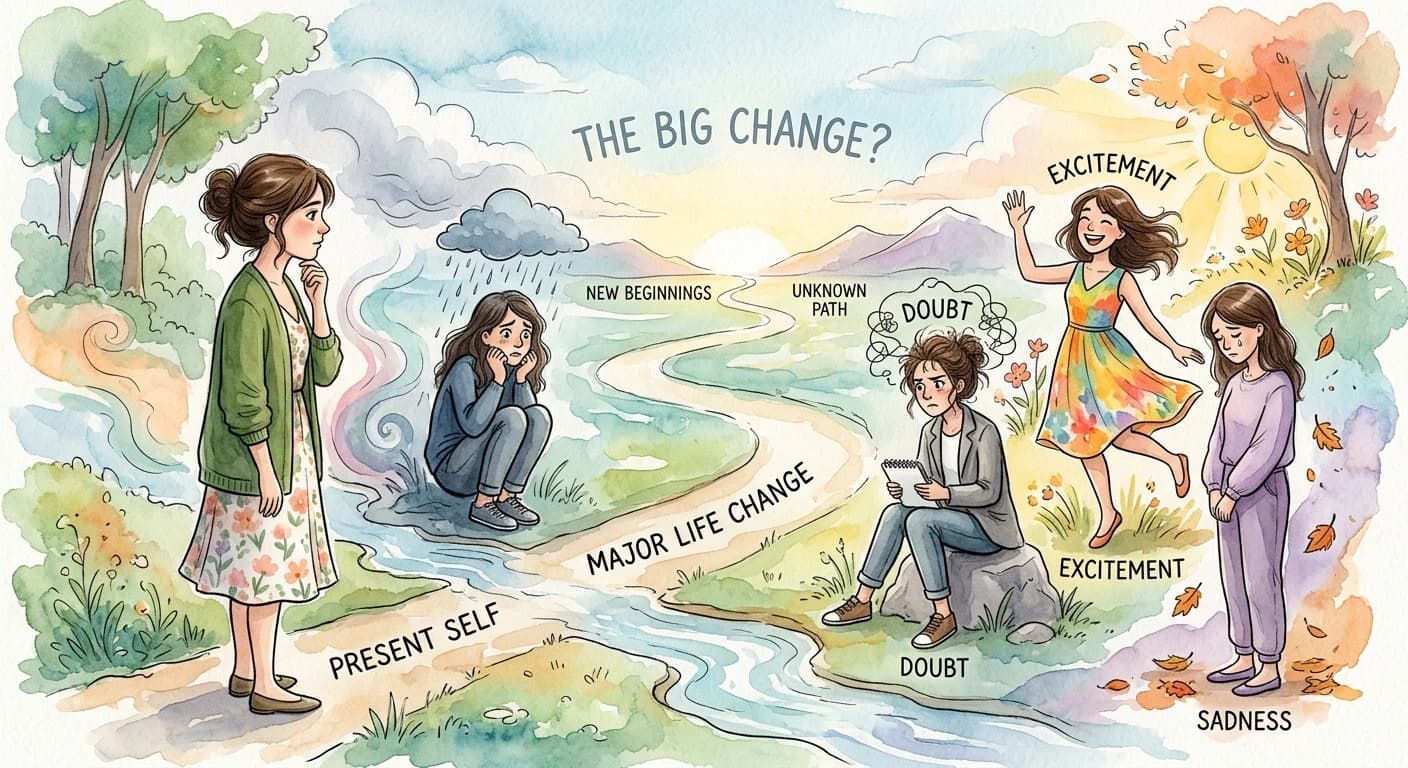
You can feel excited and terrified.
Relieved and heartbroken.
Ready to move forward and desperate to go back.
Internal Family Systems (IFS) offers a compassionate explanation for these seemingly contradictory reactions: different Parts of you may have very different feelings about the change.
Rather than asking, “Why can’t I just make up my mind?” IFS invites a different question:
Which Parts of me are trying to be heard right now?
What Counts as a Major Life Transition?
A transition does not have to be negative to activate your internal system.
Major changes can include:
- Starting or leaving a job
- Changing careers
- Moving to a new city or country
- Beginning or ending a relationship
- Getting married
- Becoming a parent
- Children leaving home
- Graduating
- Starting university
- Retirement
- Divorce or separation
- Changes in health or physical ability
- Losing someone important
- Entering a new stage of adulthood
- Making a major financial decision
- Beginning a new identity, role, or lifestyle
Even a transition you consciously chose can create uncertainty.
One Part may see possibility.
Another may see danger.
And both may genuinely be trying to help you.
Understanding Major Life Transitions Through an IFS Lens
IFS views the mind as naturally multiple. We all have Parts with different perspectives, emotions, memories, desires, and protective strategies.
IFS also describes the Self as an internal source of qualities such as compassion, curiosity, perspective, confidence, and acceptance. When Parts can make enough space for Self, Self can help mediate conflicts and guide important decisions without forcing one Part to defeat another. In fact, the IFS model specifically describes Self-leadership as helping Parts navigate major decisions about the direction of a person’s life.
During a major transition, your internal system may become much louder because uncertainty challenges the strategies your Protectors have used to keep life predictable.
You may hear:
“This is our chance. Do it.”
And almost immediately:
“Absolutely not. This is too risky.”
Another Part may add:
“You should already know what you want.”
And another:
“Can everyone please stop? I don’t want to think about this anymore.”
From an IFS perspective, this internal conflict is not evidence that something is wrong with you.
It may simply mean several Parts have important concerns about what comes next.
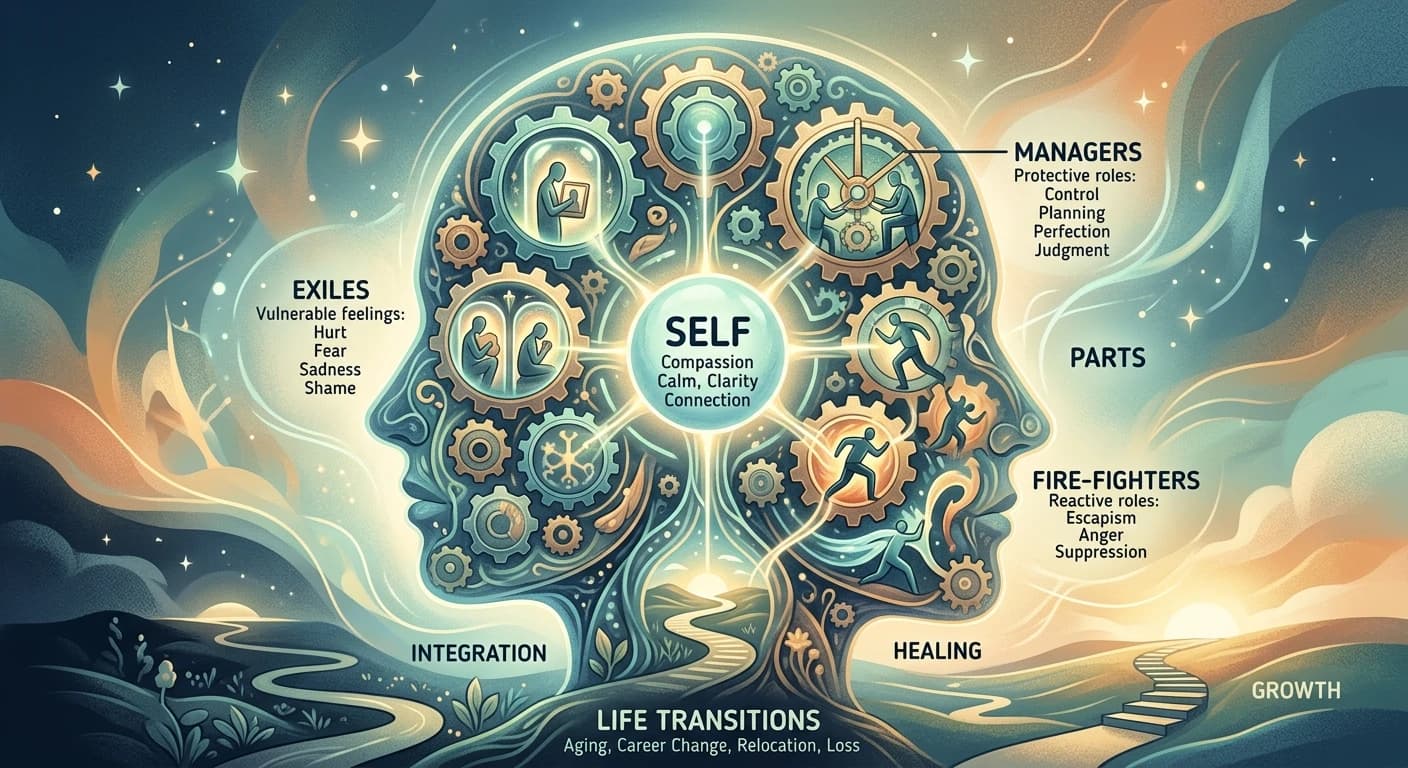
The Parts That Often Appear During Major Life Changes
Every internal system is unique, but certain protective roles frequently become more visible during periods of uncertainty.
The Safety-Seeking Part
This Part values predictability.
It may say:
“Stay where you are.”“At least we know what this life is like.”“What if the new situation is worse?”
Its job may be to protect you from disappointment, instability, rejection, or losing control.
Even when your current situation is no longer working, familiarity itself can feel safer to this Part than uncertainty.
The Growth-Seeking Part
Another Part may feel energized by possibility.
It might want adventure, freedom, intimacy, creativity, independence, or a more meaningful life.
It may say:
“We cannot keep living like this.”“There is more out there.”“Take the opportunity before it disappears.”
This Part may carry valuable information about what you want.
But if it becomes extreme, it may dismiss the legitimate fears of slower, more cautious Parts.
The Planner
The Planner responds to uncertainty by trying to eliminate it.
It may create lists, research every possible scenario, compare every option, and mentally rehearse the future.
Planning is useful.
But when a Planner believes that you must achieve complete certainty before taking action, decision-making can become exhausting.
The Part may keep asking:
“But what if we missed something?”
The Inner Critic
Transitions often bring the Inner Critic forward.
It may say:
“You are making a terrible decision.”“You should be further ahead by now.”“Everyone else has figured this out.”“You always ruin good opportunities.”
The Critic may appear cruel, but IFS encourages curiosity about its protective intention.
Perhaps it believes criticism will prevent you from making a mistake.
Perhaps it thinks shame will motivate you.
Or perhaps attacking you internally feels safer than risking criticism from someone else.
The Avoiding Part
When the internal debate becomes overwhelming, another Part may try to shut the entire process down.
You may procrastinate.
Stop responding to emails.
Avoid difficult conversations.
Scroll endlessly.
Tell yourself you will decide tomorrow.
Feel suddenly tired whenever you think about the transition.
Avoidance can look like a lack of motivation from the outside. Internally, it may be a Protector saying:
“This is too much. I need to get us away from it.”

The Grieving Part
Change almost always involves some form of ending.
Even when you are moving toward something better, there may be a Part mourning what is being left behind:
- An identity
- A home
- A community
- A routine
- A relationship
- A dream
- A younger version of yourself
- A sense of certainty
Growth and grief can exist together.
You do not have to decide that one invalidates the other.

When Two Parts Want Opposite Things: Polarization
One of the most useful IFS concepts for life transitions is polarization.
Polarization happens when Parts become locked into opposing positions.
One Part says:
“Go.”
The other says:
“Stay.”
One says:
“Take the risk.”
The other says:
“Protect what we already have.”
One says:
“We need freedom.”
The other says:
“We need security.”
IFS literature notes that difficult decisions commonly involve polarized Parts—one wanting to move in one direction while another wants the opposite. There may even be several Parts on each side.
The problem is not simply that these Parts disagree.
As polarization intensifies, each Part can become more extreme because it fears what will happen if the other Part takes control.
The cautious Part may think:
“If I relax, the impulsive Part will destroy our life.”
The adventurous Part may think:
“If I relax, the fearful Part will keep us trapped forever.”
IFS describes polarized Protectors as often intensifying their positions because neither trusts the other to step back.
The result can feel like paralysis.
But the answer is not necessarily to determine which Part is correct.
The first step is helping both Parts feel heard.
You Don't Have to Silence One Side to Make a Decision
Imagine you are considering leaving a stable job to start something new.
A Freedom-Seeking Part says:
“This job is draining us. We need to leave.”
A Security Part responds:
“Do you understand what could happen financially?”
If you immediately side with the Freedom Part, the Security Part may become louder.
If you side with Security, the Freedom Part may become resentful, impulsive, or increasingly desperate.
Instead, Self can become the mediator.
IFS work with polarization involves identifying the opposing Parts, unblending from them, understanding each Part's role and positive intention, building trust with each, facilitating communication, and eventually looking for a resolution the internal system can tolerate.
The question shifts from:
“Which Part wins?”
to:
“What is each Part trying to protect or create for me?”
Your Security Part may value stability.
Your Freedom Part may value aliveness.
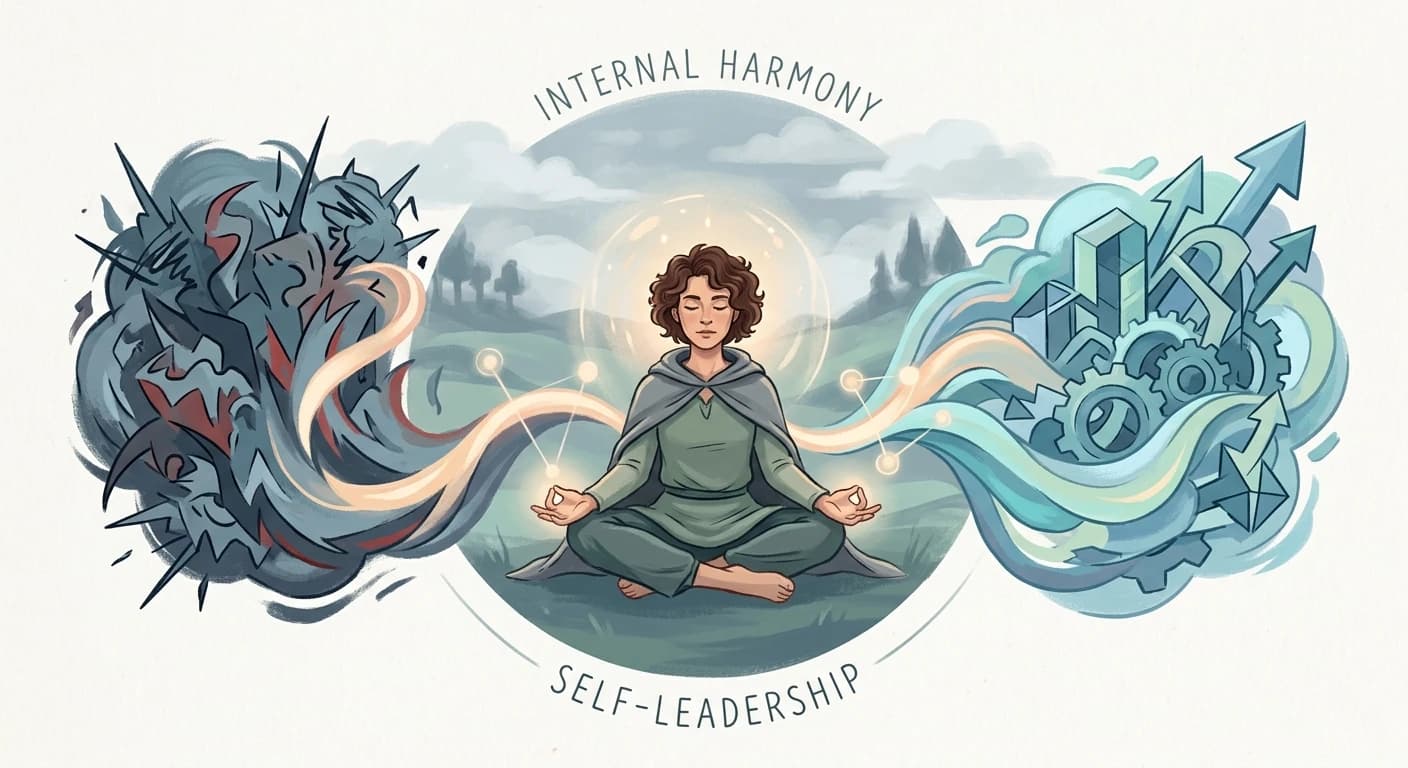
Self can hold both truths.
If you find yourself frequently stuck between two opposing Parts during major decisions, you might find our recorded Understanding and Healing Parts in Conflict (Polarizations) workshop helpful. Taught by Sasha Eslami, this $29 on-demand course dives deeper into how to identify, understand, and reconcile Parts that are in conflict, allowing you to watch and re-watch at your own pace.
Sometimes the Present Activates the Past
One reason transitions can feel disproportionately frightening is that Protectors may not be responding only to what is happening today.
A new job may activate memories of being criticized.
Moving away may activate an old fear of abandonment.
Ending a relationship may awaken a younger Part that once felt completely alone.
Starting something new may activate shame connected to previous failure.
IFS describes an advanced process known as updating Protectors. Some Protectors behave as though you still have the same vulnerability and limited resources you had when their protective roles originally developed.
That is why a transition happening at age 35 can sometimes emotionally feel like you are 8, 12, or 16 again.
A powerful IFS question is:
“How old do you think I am?”
You may be surprised by the answer.
Updating Your Protectors About Who You Are Today
If a Protector seems to be responding as though you are much younger, gently remind it about the present.
You might show the Part:
- Your current age
- The skills you have developed
- Challenges you have already survived
- Your financial or practical resources
- Your ability to leave unsafe situations
- Friends, family, therapists, or communities that support you
- Ways you can speak up for yourself now
- Choices that were unavailable when you were younger
The IFS updating process specifically involves helping Protectors recognize your present age, experience, capacities, resources, and available support so they no longer have to respond as if you were still a powerless child.
You are not telling the Protector:
“Your fear is ridiculous.”
You are saying:
“Your fear made sense when you learned this job. I want you to see what is different now.”
That distinction matters.
A Step-by-Step IFS Exercise for a Major Life Transition
Choose one transition currently activating your system.
It could be something you are considering or something already happening.
Step 1: Name the Trailhead
In IFS, a trailhead is an issue, situation, thought, emotion, or experience that gives you access to activated Parts.
For example:
“Thinking about accepting the new job.”
“Imagining moving away.”
“Thinking about ending the relationship.”
“Realizing my child is leaving home.”
IFS exercises recommend noticing the emotions, thoughts, body sensations, behaviors, and desires that arise around a trailhead because they can help identify the Parts involved.

Step 2: Notice Who Shows Up
Bring the transition gently to mind.
Notice what happens internally.
Perhaps:
- Your stomach tightens.
- Your chest feels excited.
- A voice says, “Do it.”
- Another says, “Don't be stupid.”
- You suddenly want to distract yourself.
- You feel sadness.
- You start mentally calculating everything that could go wrong.
Do not decide yet which Part deserves attention.
Just notice.
You might write:
Part: The PlannerFeels: tense and urgentSays: “We need more information.”Wants: certainty
Part: The AdventurerFeels: excited and impatientSays: “We need to go now.”Wants: freedom
Part: The Scared Younger OneFeels: small and lonelySays: “What if no one is there for us?”Wants: reassurance
IFS self-practice materials specifically encourage tracking how a Part feels, where it appears in the body, what it says, how it affects behavior, what activates it, and what it may be trying to accomplish.
Step 3: Ask the Parts for Some Space
When completely blended with a Part, its perspective can feel like the whole truth.
Instead of:
“I absolutely cannot do this.”
Try:
“A Part of me feels like I absolutely cannot do this.”
Instead of:
“I need to quit immediately.”
Try:
“A Part of me wants to quit immediately.”
This does not weaken either perspective.
It creates enough separation for Self to listen.
Step 4: Meet Each Side Separately
Ask the Part that wants change:
“What are you hoping will happen if we make this change?”
Then ask:
“What are you afraid will happen if we don't?”
Listen.
Then turn toward the Part resisting the transition:
“What are you afraid would happen if we moved forward?”
“What are you trying to protect me from?”
Do not debate either answer.
IFS emphasizes discovering the positive intent behind a Protector's role before asking it to change.
You may discover that both Parts are protecting something valuable.
Step 5: Look for What They Have in Common
Polarized Parts often appear completely opposed.
Yet underneath their strategies, they may share a common goal.
The adventurous Part wants you to leave because it wants you to have a meaningful life.
The cautious Part wants you to stay because it wants you to have a safe life.
Both care about your future.
An IFS depolarization process invites Parts to reveal their intentions, understand each other's fears, recognize common ground, and negotiate rather than continue fighting.
You might say internally:
“I hear that both of you care about me. You disagree about how to protect me, but neither of you is the enemy.”
Step 6: Ask Whether Any Younger Part Is Being Protected
Sometimes the intensity of the conflict points toward an Exile.
Ask gently:
“Are you protecting a younger Part of me?”
You might become aware of a younger Part carrying:
- Fear of abandonment
- Shame about failure
- Fear of disappointing others
- Memories of instability
- Loneliness
- Rejection
- Feeling powerless
Do not push past your Protectors to reach this Part.
IFS practice emphasizes gaining permission from Protectors before approaching Exiles, particularly when vulnerable or painful material is involved.
If the system says no, respect the no.
Trust develops when Parts discover that you will listen rather than force them.
Step 7: Update the Protector
If the Part seems to be responding from the past, ask:
“How old do you think I am?”
Then help it notice what is true today.
You can say:
“I am an adult now.”
“I can ask for help.”
“I can change my mind.”
“I have survived difficult things before.”
“I have resources we didn't have then.”
“If something goes wrong, we will deal with it together.”
Do not promise that nothing painful will happen.
Offer something more realistic:
You will not abandon your Parts if something painful happens.
Step 8: Ask Self What the Next Step Is
Notice whether there is a little more calm, curiosity, clarity, compassion, or perspective.
Then ask:
“What feels like the next Self-led step?”
Not:
“What decision guarantees I will never regret anything?”
Your next step might simply be:
- Gathering one missing piece of information
- Having a conversation
- Waiting 48 hours before deciding
- Visiting the new city
- Reviewing your finances
- Asking for support
- Setting a boundary
- Trying something temporarily
- Taking one small step toward the change
Self-leadership does not require knowing the entire future.
It means your Parts are advising you rather than fighting to take complete control.
Example: Should I Move to a New City?
Imagine Alex receives a job offer that would require relocating.
A Career Part is thrilled:
“This is exactly what we've been working toward.”
A Safety Part panics:
“We don't know anyone there.”
A People-Pleasing Part worries:
“Your family will think you're abandoning them.”
A younger Exile feels something even deeper:
“If we leave, we will be alone.”
Alex initially tries to resolve the anxiety by making endless pros-and-cons lists.
But the more the Career Part pushes, the louder the Safety Part becomes.
Through IFS exploration, Alex realizes the Safety Part is not primarily worried about the apartment, salary, or logistics.
It remembers earlier experiences of feeling isolated and unsupported.
Alex does not tell the Part:
“That happened years ago. Get over it.”
Instead:
“I understand why moving feels dangerous to you. Back then, you really were alone. Today we can choose where we live, stay connected with people, visit home, ask for help, and leave if the situation isn't right. I won't make this decision without listening to you.”
The fear may not disappear.
But the internal relationship changes.
Alex can now evaluate the job offer with more perspective instead of making the decision solely from excitement or fear.
You Can Grieve an Old Life While Choosing a New One
One of the most overlooked parts of transition is grief.
Sometimes we assume:
“If this is the right decision, I should feel happy.”
But choosing something new does not erase what mattered about what came before.
You can want the new relationship and grieve your independence.
You can be excited to become a parent and miss your old life.
You can know divorce is necessary and still miss your former partner.
You can retire willingly and mourn your professional identity.
You can move somewhere better and deeply miss home.
A Self-led system does not demand emotional uniformity.
There is room for the Part celebrating the future and the Part saying goodbye to the past.

When the Transition Has Already Happened
IFS can also help when you did not choose the change.
Perhaps you lost a job.
A relationship ended.
Your health changed.
Your family structure shifted.
Your plans did not work out.
In these situations, the work may be less about deciding what to do and more about helping the Parts reacting to what has already happened.
You might ask:
“Who inside is having the hardest time with this?”
Then:
“What does this change mean to you?”
One Part might believe:
“I failed.”
Another:
“Nothing is safe anymore.”
Another:
“We have to fix everything immediately.”
And another may simply need permission to grieve.
There is no requirement that every Part become positive about what happened.
The goal is connection, not forced optimism.
A Simple Daily Check-In During Times of Change
Transitions rarely resolve in one internal conversation.
Parts may appear at different stages.
A Part that was quiet while making the decision may become activated when the transition becomes real.
For one week, try a short daily check-in.
Ask:
What Parts are here today?
What changed since yesterday?
What is each Part worried about?
What does each Part need me to know?
Is any Part trying to rush the process?
Is any Part trying to stop it completely?
What would Self-led movement look like today?
IFS self-practice materials recommend observing Parts in real time and noting the situations, thoughts, emotions, bodily cues, and behaviors that signal activation.
A transition unfolds over time.
Your relationship with your Parts can unfold with it.
When to Seek Additional Support
Some transitions activate deeper trauma, grief, anxiety, shame, or attachment wounds.
Consider working with an IFS-trained or qualified mental health professional if:
- Your emotions frequently become overwhelming
- You experience panic or dissociation
- You feel unable to function in everyday life
- A transition is activating significant trauma
- You repeatedly feel flooded by younger Parts
- You feel trapped in an internal conflict you cannot navigate alone
- You are dealing with suicidal thoughts or concerns about your safety
IFS self-work guidance itself recognizes that there are times when Protector fears or intense Exile material make professional support more appropriate than continuing alone.
Asking for help can itself be a Self-led decision.
Final Thoughts: Change Doesn't Require Every Part to Agree
A major life transition can bring your entire internal family into the conversation.
Some Parts will be excited.
Some will be afraid.
Some will want certainty.
Some will grieve.
Some will push.
Some will resist.
IFS does not require you to eliminate these voices before moving forward.
Instead, it offers another possibility:
Listen to them without handing any single Part complete control.
The goal is not to reach a point where every Part says:
“I love this decision.”
The goal is to create enough trust that your Parts can say:
“I still have concerns—but I know you're listening.”
From there, Self can lead.
Not because the future has become certain.
But because your internal system no longer has to face uncertainty alone.
Navigate Change with IFS Guide
Major life transitions can bring many Parts to the surface at once. Having a consistent place to notice and track them can make the process easier to understand.
With IFS Guide, you can use tools such as daily check-ins, journaling, Parts exploration, Trailheads, reminders, and guided practices to stay connected with your internal system during periods of change.
Instead of asking only:
“What should I do?”
you can begin exploring:
“Who inside is speaking—and what are they trying to protect?”
That shift can create more room for curiosity, compassion, and Self-leadership as you move into whatever comes next.
Disclaimer: IFS Guide provides IFS-informed educational and self-reflection tools. It is not a substitute for psychotherapy, diagnosis, medical treatment, or emergency mental health support.
Frequently Asked Questions
IFS helps by allowing you to understand and mediate between the different Parts of you that may have conflicting feelings about the change, such as a Part that fears uncertainty and a Part that desires growth.
Yes, from an IFS perspective, even positive changes can activate protective Parts that fear the loss of familiarity or worry about new responsibilities. Acknowledging these Parts can help ease the transition.
When Parts are polarized, IFS suggests unblending from them and using Self-energy to listen to each Part's concerns and positive intentions. This helps build trust and often leads to a resolution that the internal system can tolerate, rather than forcing one Part to win.
I
Written by
IFS Guide Editorial Team

Reviewed by
Sasha Eslami
Level 3 IFS Practitioner