







Last updated November 16, 2026
Reviewed by Sasha Eslami, Level 3 IFS Practitioner · July 28, 2026
IFS Unblending: How to Separate from Your Parts
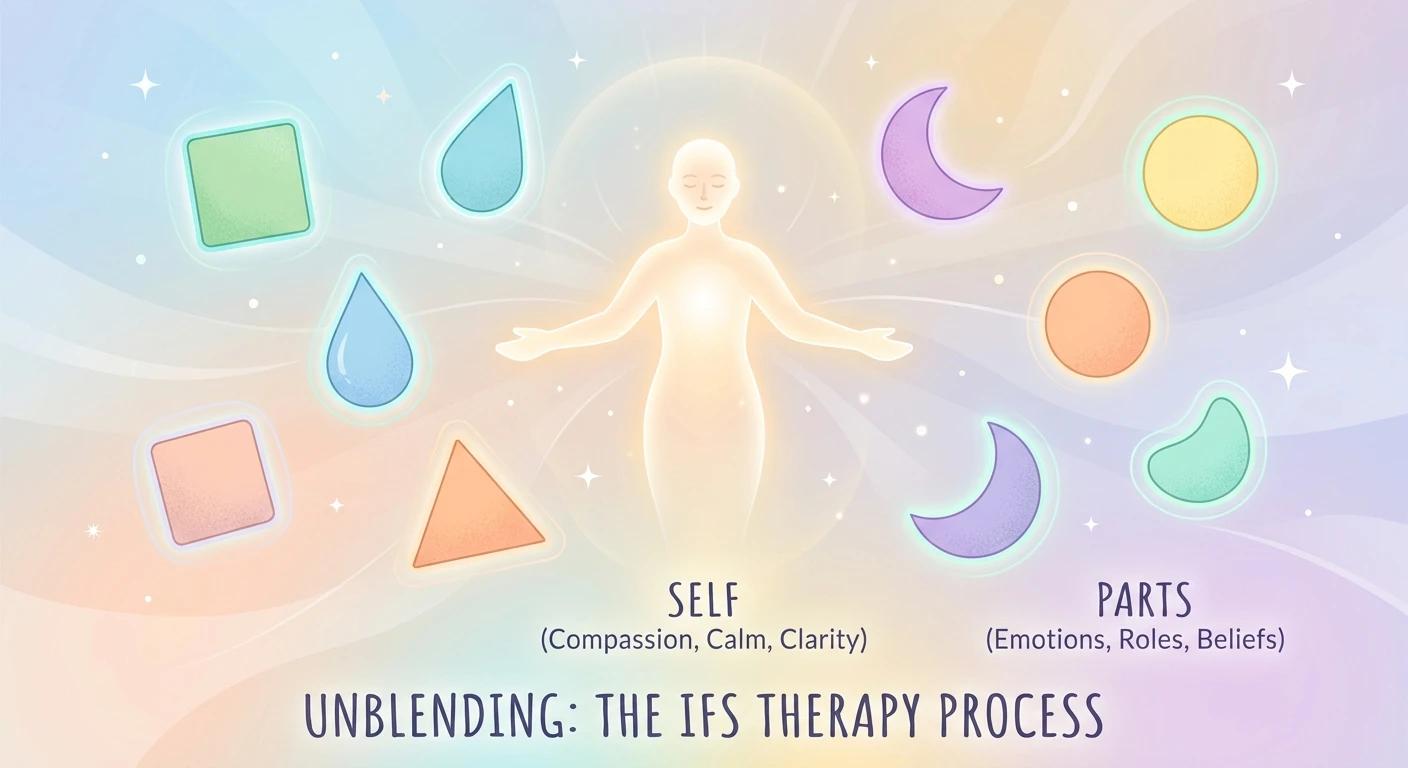
In Internal Family Systems (IFS), IFS unblending is the process of creating space between your Self and an activated part, so you can notice its feelings, thoughts and beliefs without being completely taken over by them. Rather than pushing the part away, you approach it with curiosity and compassion.
When the Parts Take Over
Ever feel like your emotions have hijacked your day? Like when anxiety transforms a minor hiccup into a full-blown crisis, or anger turns a simple disagreement into an epic showdown? That’s a classic case of blending—a term from Internal Family Systems (IFS) describing what happens when a Part takes the driver’s seat, leaving your calm and compassionate Self stuck in the backseat. 🚗💨
Unblending is the process of stepping back, separating from these overwhelmed Parts, and reclaiming your inner leadership. It’s like gently reminding your overzealous inner crew, “Thanks for the effort, but I’m in charge here!” 🌟
In this article, we’ll explore:
- What unblending is and why it’s essential.
- How blending impacts your inner system.
- Practical techniques to master unblending.
Whether you’re navigating stress, self-doubt, or emotional chaos, unblending offers a way to reconnect with your Self and lead your inner system with clarity and care. Let’s dive in! 🛠️🌿
What Is IFS Unblending?
Unblending is the art of creating space between your Self and your Parts so you can observe and engage with them without being overwhelmed by their emotions or reactions. It’s the difference between being angry and noticing that a Part of you feels angry.
Picture this: instead of starring in the inner drama as the main character, unblending helps you step into the director’s chair, viewing the scene with calm and clarity. 🎥✨

Why Unblending Matters
When you unblend, you:
- Witness your Parts with curiosity rather than judgment.
- Offer compassion and care to overwhelmed Parts.
- Regain control over how you respond to situations.
Think of unblending as upgrading from chaos to calm, like switching from a blurry camera lens to HD clarity. 📸🌟
Unblending does not mean making the feeling disappear. It means developing enough space to recognize the part's experience without treating it as your entire identity.
SituationWhen You're BlendedWhen You're UnblendedAnxiety"Everything is going to go wrong.""A part of me is worried about what might happen."Anger"I can't stand this person.""A part of me feels angry and wants to protect me."Self-Criticism"I'm a failure.""My Inner Critic is afraid I'll make a mistake."People Pleasing"I have to keep everyone happy.""A part of me fears disappointing others."Shame"Something is wrong with me.""A part of me carries shame about what happened."
Blending and unblending describe how closely you identify with the thoughts, emotions or beliefs of a part. Here is how the difference may appear in everyday life.
Blending vs. Unblending in IFS
Why Do We Blend? The Inner System at Work
Blending happens when Parts—such as Protectors or Exiles—become highly activated, overwhelming your system. Here’s why:
- Protectors Take Charge 🚨Protectors (e.g., Managers or Firefighters) rush in to shield you from perceived threats. Example: A Perfectionist Manager blends during a work deadline, flooding you with anxiety to prevent failure. Learn more about Protectors
- Exiles Cry Out 🧳💔Exiles carry unresolved pain and surface when triggered by memories or situations. Example: An Exile holding shame may take over after a critical comment, making you feel small or inadequate. What are EXILES in IFS?
- Lack of Self-Leadership 🌟When the Self isn’t leading, Parts scramble to manage the system, often resulting in internal conflict and emotional overwhelm.
Blending isn’t a flaw; it’s your system’s way of coping with stress. But without unblending, it can feel like you’re living in a constant emotional tug-of-war. 🤹♂️

The Signs You're Blended
How can you tell if a Part has taken over? Look out for:
- Intense Emotions: Overwhelming anger, sadness, fear, or guilt.
- Repetitive Thoughts: Negative self-talk dominating your inner dialogue.
- Physical Tension: Tightness, heaviness, or restlessness in your body.
- Impulsive Reactions: Acting without thinking, driven purely by emotion.
Blending often feels like being swept away by a storm—powerful, disorienting, and exhausting. 🌊
The Importance of Unblending in IFS
Unblending restores balance and empowers your Self to lead. Here’s why it’s crucial:
- Clarity: See your Parts for what they are—well-intentioned protectors or wounded Exiles.
- Compassion: Approach activated Parts with care rather than frustration.
- Choice: Respond thoughtfully instead of reacting impulsively.
When you unblend, you swap the chaos of a noisy debate for the calm focus of a trusted mediator. 🛋️💬

Practical Techniques for Unblending
- Pause and Name the Part 🛑📛Take a moment to notice what’s happening. Identify the Part that’s activated. Example: “A Part of me feels really angry right now.” Why it works: Naming the Part creates emotional distance and reminds you that you are not the Part.
- Focus on Physical Sensations 🌡️💪Pay attention to where the Part’s energy shows up in your body. Example: “I feel tightness in my chest and a knot in my stomach.” Why it works: Grounding in physical sensations interrupts mental spirals and brings you back to the present moment.
- Speak to the Part with Curiosity 🤔💛Gently dialogue with the Part. Ask: “What are you trying to protect me from?” “What do you need from me right now?” Why it works: Curiosity builds trust, encouraging the Part to relax its intensity.
- Use Visualization Techniques 🌈🖼️Imagine the Part as a separate figure or object. Visualize it stepping back, giving you some space. Why it works: Reinforces the idea that you and the Part are distinct entities.
- Affirm Self-Leadership 🌟💪Remind yourself that the Self can handle the situation. Affirmations like: “I’m here, and I can manage this.” “Thank you for your effort. Let me take the lead.”
A Simple IFS Unblending Exercise
You can practice unblending in everyday moments when a thought or feeling seems to take over. There is no need to force a part to change.
- Notice what is happening. Pause and identify the strongest feeling, thought or reaction present.
- Acknowledge the part. Try saying, "A part of me is feeling this right now."
- Notice how you feel toward it. Are you curious, compassionate, frustrated or afraid? If you feel judgment or frustration, another part may also be present.
- Ask for a little space. Gently ask whether the activated part would be willing to give you enough space to get to know it. Do not force it.
- Listen with curiosity. If you feel ready, ask what the part wants you to know or what it is concerned might happen.
- Appreciate its efforts. Thank the part for sharing what it can, even if it is not ready to step back.
If a part does not want to unblend, that is useful information too. Rather than pushing it away, you can explore what it fears might happen if it gives you more space.
The goal is not to silence anxiety. It is to build a relationship with the part carrying it, while allowing more room for curiosity and choice.
Example: Unblending from an Anxious Part
<b>You:</b> I notice a part of me is really anxious about tomorrow.<br><br><b>Anxious Part:</b> What if everything goes wrong?<br><br><b>You:</b> I can see you're worried. What are you afraid might happen?<br><br><b>Anxious Part:</b> I don't want you to embarrass yourself.<br><br><b>You:</b> Thank you for trying to protect me. Would you be willing to give me a little space so I can understand you better?<br><br><b>Anxious Part:</b> Maybe, but please don't ignore me.<br><br><b>You:</b> I won't. We can take this slowly.
This is an illustrative example, not a real client session.
Unblending can sometimes bring up strong feelings, especially when parts are connected to painful memories or trauma. If you feel overwhelmed, pause the exercise and return your attention to the present. Self-guided IFS is not a substitute for professional therapy. Consider working with a trained IFS therapist when exploring intense or traumatic experiences. If you are in crisis or thinking about harming yourself, contact your local emergency number. In the US, call or text 988. Outside the US, find a free helpline at findahelpline.com.
Real-Life Examples of Unblending
Scenario 1: Workplace Anxiety
- Blending: A Perfectionist Part floods you with fear of failure before a presentation.
- Unblending: You pause, name the anxiety, and reassure the Part: “I know you want me to do well. I’ve got this.”
Scenario 2: Anger in a Heated Argument
- Blending: A Protector Part lashes out in anger during a disagreement.
- Unblending: You notice tension in your body, name the anger, and calmly ask the Part what it’s trying to protect.
The Benefits of Unblending
Mastering unblending can bring profound benefits:
- Emotional Regulation: Stay calm and centered, even under stress.
- Inner Harmony: Cultivate cooperation and trust among your Parts.
- Self-Connection: Strengthen clarity, compassion, and leadership within.

Unblending is like shifting from survival mode to thriving mode—empowering and transformative. 🚀
IFS and Advanced Unblending Techniques Offline Course
Conclusion: Reclaiming Inner Balance
Unblending is the cornerstone of inner harmony in IFS. By separating from overwhelmed Parts, you allow your Self to lead with calm, curiosity, and compassion.
So next time a Part takes over, remember: it’s not about silencing or dismissing it—it’s about listening and responding with care. Take a deep breath, unblend, and step into your power. 🌟💪
(Want a supportive way to track and reflect on unblending moments?
Check out the IFS Guide App for journaling features and other IFS-based tools that help you build a consistent, empowered practice of Self-leadership.)
Your journey to inner peace starts one unblending moment at a time. 🕊️✨
References
- Schwartz, R. C. (2021). No Bad Parts: Healing Trauma and Restoring Wholeness with the Internal Family Systems Model. Sounds True.
- Schwartz, R. C., & Sweezy, M. (2020). Internal Family Systems Therapy (2nd ed.). Guilford Press.
- IFS Institute. The Internal Family Systems Model Outline. https://ifs-institute.com/resources/articles/internal-family-systems-model-outline
I
Written by
IFS Guide Editorial Team

Reviewed by
Sasha Eslami
Level 3 IFS Practitioner