









Last updated July 12, 2026
Reviewed by Sasha Eslami, Level 3 IFS Practitioner · July 12, 2026
Integrating IFS with CBT: A Practical Guide
Last updated: July 12, 2026
This guide is for therapists, coaches, and self-healers who want a practical way of integrating IFS with CBT while respecting the depth of both approaches.
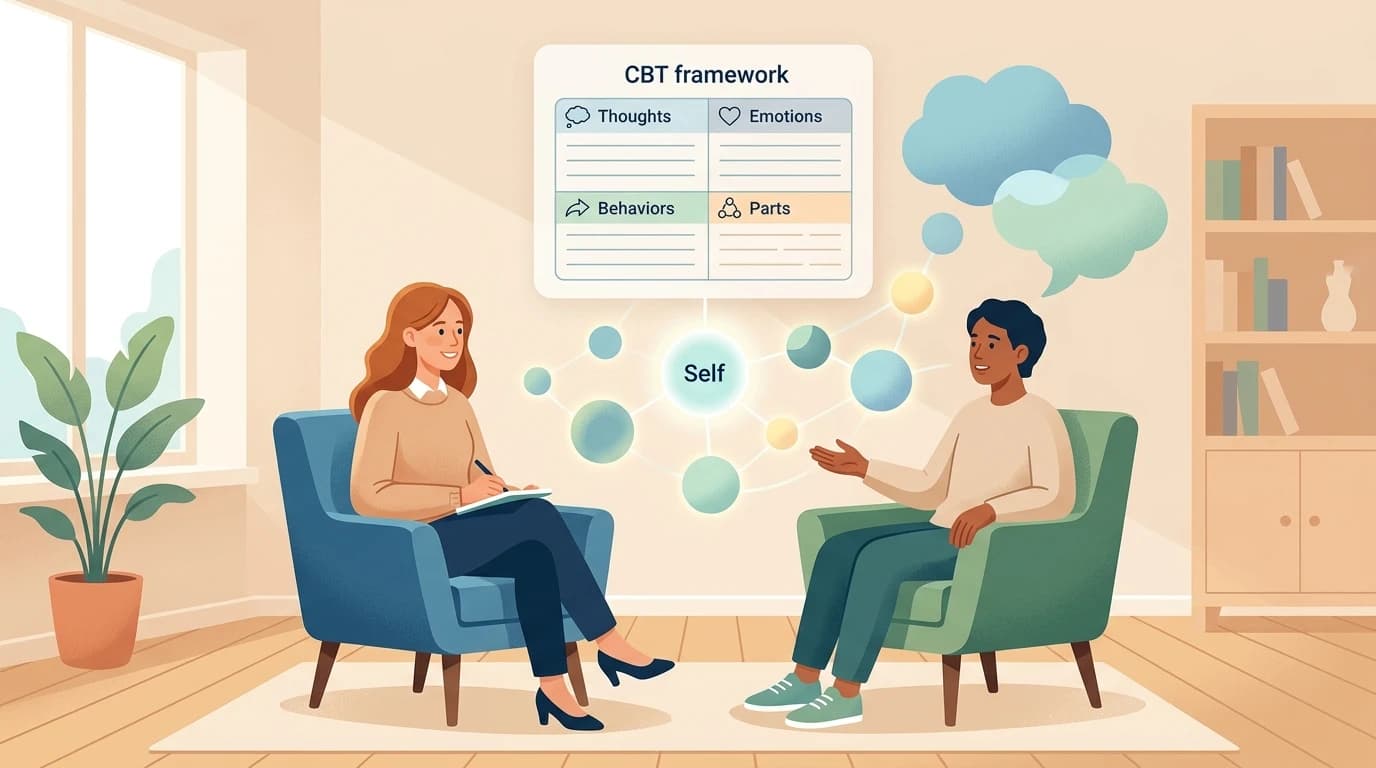
Bridging CBT Structure with IFS Parts Work
CBT helps you notice and change unhelpful thought and behavior patterns; IFS helps you understand the Parts carrying fear, shame, protection, or old wounds. If you’re newer to parts work, start with the IFS learning library for foundational concepts.
Together, they offer a grounded path to healing: CBT brings structure and action, while IFS brings compassionate inner understanding.
Understanding the Core Differences Between IFS and CBT
What is CBT?
Cognitive Behavioral Therapy focuses on how our thoughts influence our emotions and behaviors. In simple terms: when a thought changes, the feeling and action that follow it may shift too.
Common CBT tools include:
- Cognitive Restructuring – Spotting and challenging distorted thoughts
- Behavioral Activation – Doing positive activities to boost mood
- Exposure Therapy – Gradually facing fears and anxieties
- Mindfulness – Staying present and observing thoughts non-judgmentally
CBT is great at giving you practical, everyday skills. But it doesn’t always address deeper emotional wounds beneath a thought pattern. Think of it as strong topsoil: sometimes you also need to dig deeper to reach the hidden roots. For a broader comparison, see IFS vs CBT.
What is IFS?
Internal Family Systems treats your psyche like a “family” of Parts—some protective, some wounded, all longing for harmony. Each Part carries specific beliefs, emotions, and memories. And at your core? The calm, wise Self capable of healing them all.
Learn more about Self in IFS
Key IFS ideas:
- Managers: Over-planners, perfectionists, or that nagging inner voice.
- Firefighters: React quickly to extinguish distress, sometimes through distraction or numbing. What are Firefighters in IFS?
- Exiles: Wounded Parts carrying shame, fear, or sadness. What are Exiles in IFS?
- Self: That compassionate, healing core beneath all the noise.
Where CBT might say, “Let’s reframe the thought, ‘I’m a failure,’” IFS says, “Let’s talk to the Part feeling like a failure and discover what it truly needs.”
Why Combine IFS and CBT?
You might be thinking, “Aren’t they complete on their own?” They can be. But combining them can unlock useful synergy when the client needs both practical tools and deeper emotional understanding.
- CBT brings structure and tools for reshaping thoughts.
- IFS dives into the emotional depths, healing the wounded Parts that create those thoughts.
Together, they provide:
- Actionable Change – CBT for day-to-day coping.
- Deep Emotional Healing – IFS for unburdening deeper wounds.
- Balanced Perspective – Address both logic and emotion.
Rather than just placing a new thought on top of an old wound, you can work with the wound and adopt healthier thinking patterns. That is where the integration becomes especially powerful.
How to Start Integrating IFS with CBT in Therapy and Self-Work
1. Using CBT to Identify Negative Thought Patterns, Then Exploring the Parts Holding Them (IFS)
Scenario: A client thinks, “I’m not good enough.”
- CBT Step: Recognize it’s a distorted thought (e.g., all-or-nothing thinking).
- IFS Step: Ask which Part holds this belief. Is it a Critical Manager? A fearful Exile?
- Healing: Instead of simply swapping in a more positive thought, you listen to the Part, acknowledge its fears, and help it heal.
Phrase to try: “A part of me believes I’m not good enough. Can I get curious about what this Part is afraid would happen if it stopped saying that?” This turns self-criticism into a conversation with an inner protector instead of a battle against yourself.
2. Addressing Cognitive Distortions While Understanding Their Protective Purpose
CBT teaches us that our minds can warp reality with errors like catastrophizing or mind reading. IFS adds a deeper question: why does this distortion keep appearing?
- CBT Step: Identify the distortion (“I always fail,” “Everyone hates me”).
- IFS Step: Meet the Part generating these thoughts. It might be a Protector fearing pain or an Exile carrying old shame.
- Healing: Show the Part empathy, gently helping it realize it’s safe now.
So, you’re not just “fixing” a thought; you’re also relieving the emotional burden behind it. Think of it as healing the engine, not just repainting the car.
3. Using CBT’s Exposure Therapy with IFS’s Self-Led Healing
Exposure therapy can be invaluable for fears or phobias, but it may alarm protectors if they feel pushed too quickly.
- CBT Step: Gradual exposure to the scary situation.
- IFS Step: Before exposure, talk with any anxious Parts. Assure them you won’t override their concerns.
- Healing: Let your Self guide the process, ensuring no Part feels forced or ignored.
Example: For social anxiety, IFS helps you befriend the Exile terrified of rejection before you jump into a crowded room. The exposure can still happen, but it happens with more inner consent.
4. Using CBT’s Behavioral Activation Alongside IFS’s Internal Dialogue
Behavioral activation is all about scheduling positive, mood-boosting activities. But what if a Part resists?
- CBT Step: Choose activities that bring joy or a sense of achievement.
- IFS Step: Ask the resistant Part, “What’s your concern with doing this activity?”
- Healing: Address the Part’s fears—maybe it’s worried about failure or criticism—so it feels safe to move forward.
This helps ensure the new activity doesn’t get sabotaged by an unhealed Part that is trying to keep you safe.
Case Example: Using IFS and CBT Together in Therapy
Client Issue: A woman feels constantly rejected in her relationships.
- CBT identifies her thought “No one really likes me.” She learns to question this thought and look for evidence.
- IFS uncovers an Exile carrying childhood memories of being ignored. This Part still fears rejection.
- Integration: She challenges negative thoughts with CBT, dialogues with the Exile in IFS, and helps Protectors learn it is safer to trust.
Result? She not only changes her thinking but also heals the root wound driving it, which can lead to deeper and more lasting transformation.
Practice IFS and CBT Skills Between Sessions with the IFS Guide App
The IFS Guide App can support this kind of integration between sessions. Use AI-guided IFS Sessions to check in with Parts behind recurring thoughts, Daily Check-Ins to notice patterns, Parts Mapping to track inner dynamics, and guided meditations to return to Self-led awareness before practicing CBT tools.
Conclusion: The Power of Integrating IFS and CBT
On their own, IFS and CBT are pretty fantastic. But when you fuse them, you get:
- Comprehensive Healing – From surface-level thoughts to deep inner Parts.
- Compassionate Structure – Practical steps (CBT) + warm, validating Parts work (IFS).
- Long-Term Change – Because you address both immediate concerns and underlying emotional drivers.
If you’re a therapist, consider weaving these approaches into your sessions thoughtfully. If you’re on a self-growth journey, explore how CBT’s tools can work hand-in-hand with IFS self-inquiry. You may find that useful middle ground where action meets empathy and change becomes more sustainable.
What’s your experience with these approaches? Let’s keep the conversation going and create even richer paths to healing!
Yes. CBT can help identify and test unhelpful thoughts, while IFS can explore the Parts that hold or protect those beliefs. Together, they can support both practical behavior change and deeper emotional healing.
Not always. Some people benefit from one model on its own. Integration is most helpful when a person needs both structure, such as thought records or behavioral experiments, and compassionate exploration of the Parts behind the pattern.
If someone is overwhelmed or needs immediate coping skills, CBT tools may help create stability first. If the same thought pattern keeps returning despite logical reframing, IFS may help reveal the protective or wounded Parts underneath.
Yes. CBT can identify anxious predictions and avoidance behaviors, while IFS can help you connect with the Parts that fear danger, rejection, failure, or loss of control.
A common mistake is using CBT to argue with a Part or force it to change. In an IFS-informed approach, you first get curious about the Part’s protective purpose, then introduce CBT tools with more compassion and consent.
I
Written by
IFS Guide Editorial Team

Reviewed by
Sasha Eslami
Level 3 IFS Practitioner