









Last updated July 19, 2026
Reviewed by Sasha Eslami, Level 3 IFS Practitioner · July 19, 2026
IFS and Mindfulness: Integrating Parts Work with Present-Moment Awareness
This guide is for therapists, coaches, and self-healers who already know the basics of Parts work and want to bring more present-moment awareness into their IFS practice. If you tend to get pulled into anxious thoughts, emotional intensity, or inner criticism during Parts work, mindfulness can help you slow down and stay connected to Self.
IFS and Mindfulness-Based Therapies

The Power of IFS and Mindfulness in Therapy
In the world of psychotherapy, IFS and mindfulness-based therapies, such as Mindfulness-Based Stress Reduction (MBSR) and Mindfulness-Based Cognitive Therapy (MBCT), have each gained recognition for their effectiveness in healing emotional wounds, reducing stress, and cultivating Self-awareness.
But what happens when these two powerful approaches are blended together? The results can be deeply supportive.
By integrating IFS with mindfulness practices, therapists and clients can:
- Deepen awareness of Parts while staying grounded in the present moment
- Strengthen Self-leadership by using mindfulness to regulate emotions
- Improve the ability to unblend from overwhelmed Parts
- Foster a greater sense of inner peace and balance
This article will explore the synergies between IFS and mindfulness, how they can be integrated into therapy, and practical exercises for using mindfulness to support IFS healing work.
Explore the IFS learning library for foundational guidance on Parts, Self, and the IFS model.
Understanding IFS and Mindfulness: A Natural Fit for Healing
What is Internal Family Systems (IFS)?
IFS, developed by Dr. Richard Schwartz, is a Parts-based therapeutic model that views the psyche as made up of:
- Self – The core, compassionate leader of the internal system
- Managers – Proactive Parts that try to control emotions and maintain stability
- Firefighters – Reactive Parts that use distraction or numbing to cope
- Exiles – Wounded Parts that carry deep emotional pain or trauma. For more structure, explore the IFS 6 F’s process for connecting with Parts and Exiles.
IFS helps individuals build a relationship with these Parts, unburden wounded Exiles, and bring balance through Self-leadership. It is a way of helping the inner system relate with more clarity, compassion, and cooperation.
What is Mindfulness-Based Therapy?
Mindfulness-based therapies, including MBSR, MBCT, and Acceptance and Commitment Therapy (ACT), focus on cultivating:
- Present-moment awareness
- Nonjudgmental observation of thoughts and emotions
- Compassionate self-acceptance
- Emotional regulation through breath and body awareness
Mindfulness encourages individuals to observe emotions and thoughts without identifying with them, making it highly compatible with IFS principles. It can serve as a steadying guide for a busy inner world.

Why IFS and Mindfulness Are a Powerful Combination
Although IFS and mindfulness were developed separately, their underlying philosophies align perfectly:
- Both Promote Inner Awareness IFS teaches Parts awareness, while mindfulness encourages observing thoughts and emotions nonjudgmentally.
- Both Encourage Nonjudgmental Curiosity IFS helps clients approach their Parts with curiosity and compassion, which mirrors mindfulness’s nonjudgmental stance toward thoughts and emotions.
- Both Reduce Emotional Reactivity Mindfulness creates distance from overwhelming emotions, making it easier to unblend from reactive Parts in IFS.
- Both Empower Self-Leadership By quieting mental noise, mindfulness strengthens access to Self-energy, which is essential for healing in IFS.
A helpful rule of thumb: mindfulness helps you notice what is happening; IFS helps you build a relationship with who is experiencing it.
— Practice note

Integrating Mindfulness into IFS Therapy: Step-by-Step Guide
Step 1: Using Mindfulness to Identify Blended Parts
When an individual feels overwhelmed by emotions, mindfulness can help them pause and observe.
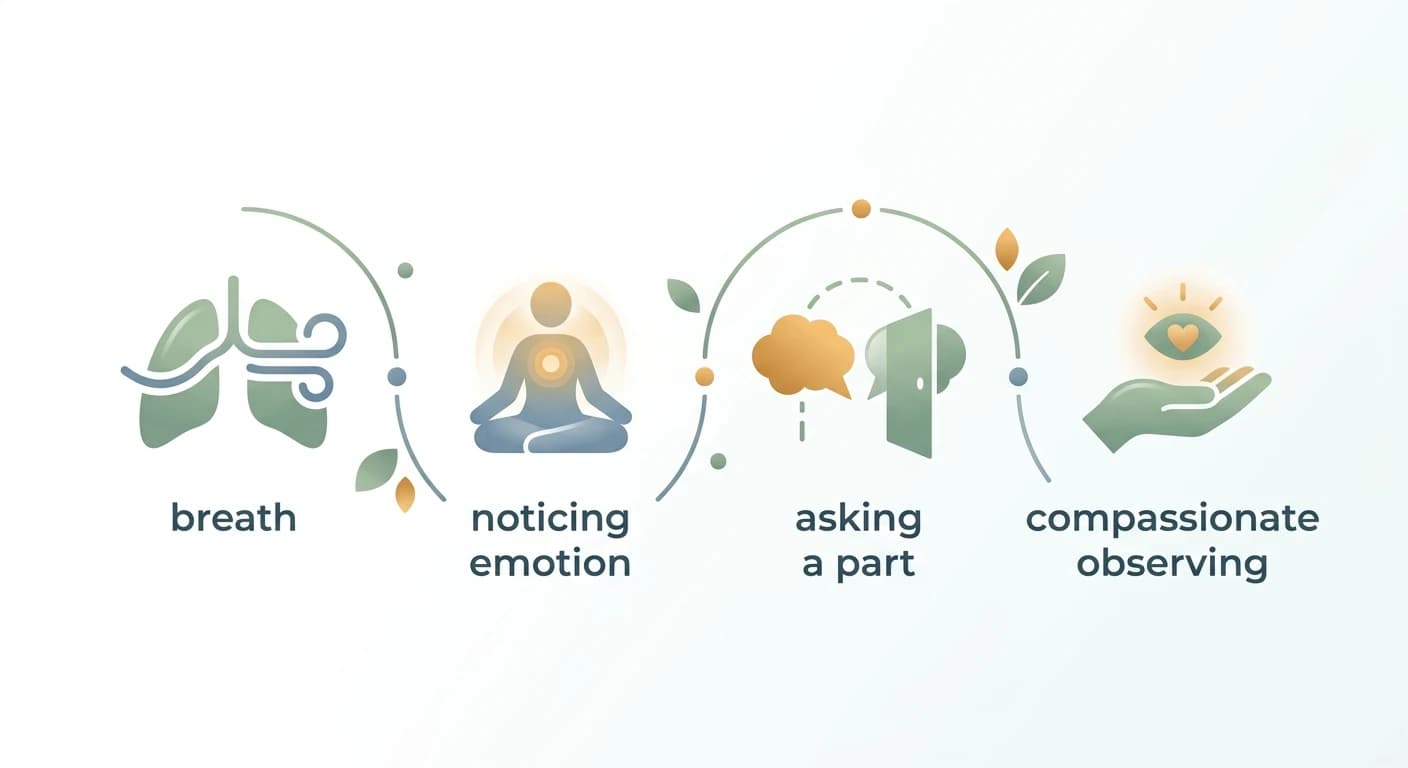
Exercise: Mindfulness Check-In
1. Sit quietly and focus on your breath.
2. Notice what emotions are present.
3. Ask: “Is there a Part that feels active right now?”
4. Observe the sensation without judgment.
Why It Works: Instead of getting lost in the emotion, mindfulness helps individuals recognize that a Part is present and separate from their core Self.
For a deeper look at this skill, read IFS and advanced unblending techniques.
Step 2: Using the Breath to Stay in Self While Engaging Parts
IFS requires that Self be the leader. However, some Parts may hijack the system, making it hard to stay calm and compassionate.
Exercise: Breath Awareness for Self-Leadership
1. Take a deep breath in and exhale slowly.
2. Imagine your breath creating space between you and the Part.
3. Repeat: “I am here, and I can listen to you.”
4. Continue breathing and remain in Self-energy.
Why It Works: The breath helps calm Protectors and Firefighters, allowing Self to lead the interaction like a peaceful lighthouse guiding ships in a storm.

Step 3: Mindfulness for Unblending from Overwhelming Parts
When a Part is too activated, mindfulness can help create separation between Self and the emotion.
Exercise: The “Observer” Technique
1. Close your eyes and visualize the overwhelming Part in front of you.
2. Imagine yourself stepping back and watching the Part from a distance.
3. Say: “I see you, and I want to understand you.”
4. Observe what happens when you hold a compassionate, nonjudgmental stance.
Why It Works: Mindfulness interrupts emotional fusion, allowing for Self-led communication with Parts, like pressing the “pause” button on a hectic scene.
Step 4: Grounding the Body to Support IFS Healing
Since many Exiles hold trauma and emotional pain, mindfulness-based body awareness can help release stored tension.
Exercise: Body Scan for Exile Healing
1. Bring attention to areas of tension in the body.
2. Ask: “Is there a Part holding pain here?”
3. Breathe deeply and offer compassion to the sensation.
4. Imagine sending warmth and comfort to the area.
Why It Works: This allows Exiles to release burdens gently without overwhelming the system, making emotional release feel more like a soothing hot bath than a tidal wave.

- Using mindfulness to bypass Parts: The goal is not to make feelings disappear. It is to notice them clearly enough to relate to them with compassion.
- Forcing calm too quickly: Some Parts need to be heard before the body can settle. Slow breathing can support the process, but it should not become another form of control.
- Analyzing instead of listening: If you find yourself explaining a Part rather than sensing it, pause and ask what it wants you to understand.
- Moving toward Exiles too fast: If Protectors object, respect their pace. Mindfulness can help you stay present with the Protector first.
Common Mistakes to Avoid
Self: I notice tightness in my chest. Is there a Part here that wants my attention?
Anxious Part: If I don’t stay alert, something will go wrong.
Self: That makes sense. You’ve been trying to protect me. Would it be okay if I stayed with you while we take a few breaths?
Anxious Part: Maybe, as long as you don’t ignore me.
Self: I won’t ignore you. I want to understand what you need me to know.
A Mini-Dialogue Example
- “I notice something in me feels anxious. I don’t have to become it.”
- “Can I give this Part a little space and listen from Self?”
- “I’m here with you. I’m not trying to push you away.”
- “What are you afraid would happen if you didn’t do your job?”
- “Let’s slow down. We can take one breath before we continue.”
Phrases to Try During Mindful Parts Work
The most useful IFS and mindfulness practices are often simple, repeatable, and gentle. These examples can help you bring the ideas into real moments instead of keeping them as theory.
Real-Life Example: IFS and Mindfulness in Action
Case Study: Managing Anxiety with IFS and Mindfulness
Client: Rachel, a 34-year-old woman struggling with anxiety and perfectionism.
- IFS Discovery:Rachel identified a Perfectionist Manager pushing her to work constantly. She also found an Exile carrying childhood shame.
- Mindfulness Integration:Before engaging the Manager, Rachel practiced breath awareness to stay grounded in Self. While witnessing the Exile, she used body scanning to connect to emotions safely.
Outcome: By using mindfulness to regulate emotions, Rachel was able to dialogue with her Parts more effectively and reduce self-criticism.
How IFS and Mindfulness Can Be Used in Therapy Sessions
- Trauma Processing IFS works with Parts that hold trauma, while mindfulness helps prevent emotional flooding.
- Anxiety Reduction Mindfulness reduces physiological symptoms, making it easier to soothe anxious Protectors. You can also explore IFS for anxiety, stress, and overwhelm.
- Depression Recovery Mindfulness-based self-compassion helps reconnect with Exiles carrying sadness.
- Emotional Regulation IFS provides a framework for understanding triggers, while mindfulness helps people respond instead of react.
To support your practice between sessions, the IFS Guide App offers AI-guided IFS sessions, Daily Check-Ins, Self-Healing Meditations, and Parts Mapping to help you stay connected to your inner system with more consistency and compassion.
Conclusion: A Holistic Approach to Emotional Healing
Blending IFS and mindfulness creates a practical, holistic approach to emotional healing. Mindfulness helps you slow down and notice what is happening; IFS helps you understand who inside is reacting and what they need. Together, they can support greater Parts awareness, stronger emotional regulation, deeper compassion for Exiles, and more stable Self-leadership over time.
If you’re a therapist or an individual on a healing journey, integrating mindfulness into your IFS practice can be truly transformative. (After all, who couldn’t use a little extra calm and compassion in their life? 🌟)
If you’re a therapist or an individual on a healing journey, integrating mindfulness into your IFS practice can be truly transformative. A little more calm and compassion can make the inner work feel safer and more sustainable.
- Who this is for: people using IFS personally or professionally who want a steadier way to meet activated Parts.
- What you’ll practice: short mindfulness check-ins, breath-based grounding, unblending prompts, and body awareness exercises.
- What to watch for: trying to force calm, bypassing Parts, or using mindfulness to push feelings away instead of listening to them.
Frequently Asked Questions About IFS and Mindfulness
No. Mindfulness helps you observe thoughts, emotions, and body sensations in the present moment. IFS goes a step further by helping you relate to those experiences as Parts with intentions, fears, and needs.
It can if it is used to distance yourself from feelings without building a relationship with the Parts behind them. In IFS, the goal is not detached observation alone. The goal is compassionate presence from Self.
That is common. Start smaller: feel your feet, notice one breath, name one sensation, or open your eyes and orient to the room. If a Part is highly activated, grounding may need to come before deeper Parts dialogue.
Not necessarily. A short check-in can be enough. Even one minute of breath awareness or body awareness can help you notice whether you are blended with a Part before beginning IFS work.
Yes, but gently. Mindfulness-based body awareness can help you stay present with vulnerable feelings, but Exile work should move at a pace the whole system can tolerate, especially if trauma is involved.
I
Written by
IFS Guide Editorial Team

Reviewed by
Sasha Eslami
Level 3 IFS Practitioner