









Last updated July 28, 2026
Reviewed by Sasha Eslami, Level 3 IFS Practitioner · July 28, 2026
Somatic IFS: Healing Through the Body

Start Here: The Body Holds the Story
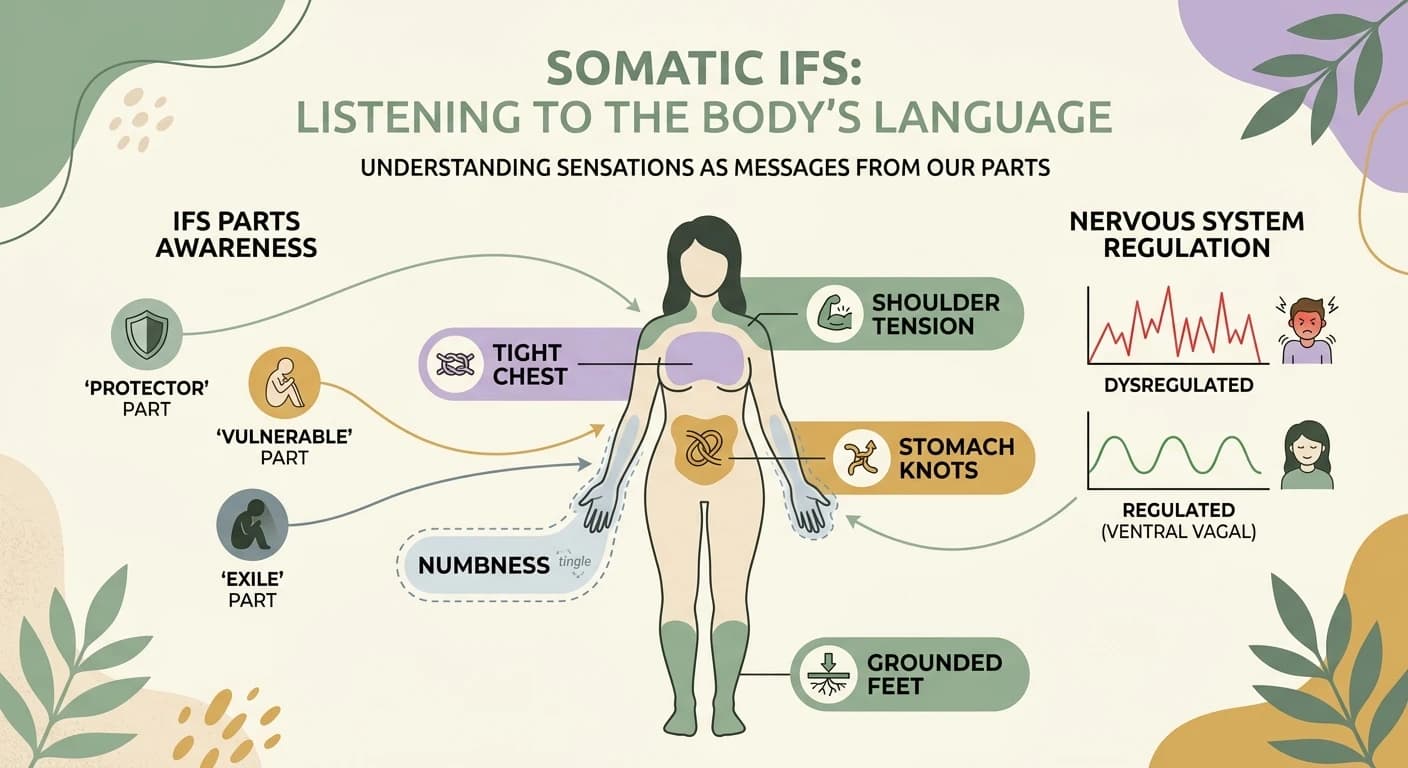
Emotions often speak through the body: a tight chest, heavy shoulders, or a knotted stomach.
Somatic Internal Family Systems, or Somatic IFS, brings body awareness into IFS work by helping you notice the sensations, posture, breath, and tension that Parts may use to communicate.
What Is Somatic IFS?
Somatic IFS is an approach that integrates the principles of Internal Family Systems (IFS) therapy with somatic (body-based) awareness and interventions. It acknowledges that our Parts don’t just live in the mind—they are also deeply connected to bodily sensations, muscle tension, posture, and movement.
Learn more about What are Parts in IFS
While traditional IFS primarily focuses on dialogue with Parts through thoughts and emotions, Somatic IFS invites the body into the conversation. This approach allows deeper access to the wisdom of Exiles, the defenses of Protectors, and the burdens stored in the nervous system.
Key Differences Between Traditional IFS and Somatic IFS
How Trauma and Emotions Are Stored in the Body
Trauma and difficult emotions don’t just exist as memories—they leave imprints in the body. Neuroscience research shows that when we experience overwhelming events, the nervous system encodes these experiences physically, often as tension, pain, or postural habits.
For example:
- A person who experiences chronic stress may hold tension in their jaw, shoulders, or gut.
- A childhood Exile who felt powerless might cause the body to collapse inward, creating a posture of self-protection.
- A Firefighter that numbs pain through avoidance may cause a disconnect from bodily sensations, leading to a lack of awareness of physical needs.
Somatic IFS helps bridge the gap between stored bodily trauma and psychological healing by encouraging curiosity about physical sensations and exploring their connection to Parts.
The Connection Between Parts and Somatic Experiences
In IFS, we work with Protectors, Firefighters, and Exiles—each carrying burdens in the mind and body. These burdens often manifest as physical sensations, chronic pain, or energy blockages.
What are Protectors in IFS?
Common Somatic Experiences and Their Related Parts
- Tight chest, shallow breathing → Anxious Protector
- Shoulder tension, jaw clenching → Perfectionist Manager
- Heavy limbs, fatigue → Depressed Exile carrying grief
- Numbness or disconnection → Firefighter trying to avoid pain
- Gut issues, stomach knots → A Part struggling with fear or shame
By tuning into these sensations and inviting Parts to communicate through the body, we open a new pathway for healing that doesn’t rely solely on words. 🗣️💬
Practical Somatic IFS Techniques for Healing
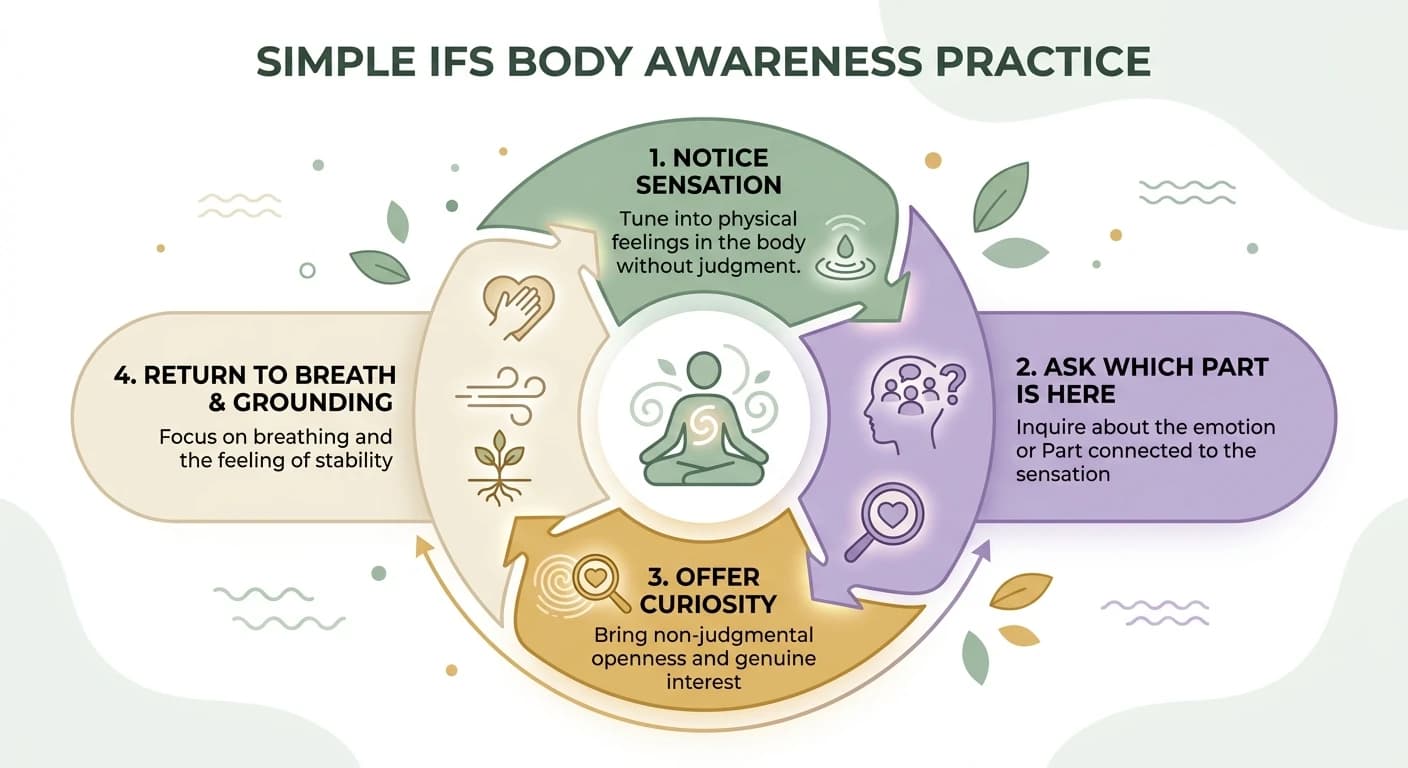
You don’t need a complicated practice to begin. These simple techniques can help you bring body awareness into IFS work with more steadiness and care:
- Body scanning: Slowly scan from head to toe and notice tightness, warmth, tingling, heaviness, or numbness. Ask, “Is there a Part that lives here?”
- Grounding: Feel your feet on the floor, place one hand on your chest or belly, and let your exhale lengthen. Notice whether any Part feels safer.
- Touch and self-holding: Try a gentle hand on the heart, a self-hug, or soft pressure on the arms to offer reassurance to vulnerable Parts.
- Movement exploration: If a Part feels stuck, try stretching, swaying, shaking out the hands, or gently pressing the feet into the ground.
- Breathwork: Inhale for four counts, pause briefly, and exhale for six counts. Use the breath to create space between Self and an overwhelming Part.
Enhance Your IFS Practice with the IFS Guide App
The IFS Guide App can support body-based IFS practice with AI-guided sessions, Daily Check-Ins, adaptive Self-Healing Meditations, and Parts Mapping. It’s especially helpful when you want a gentle structure for noticing sensations, tracking Parts, and returning to Self-led awareness between sessions.
Real-Life Example: Somatic IFS in Action
Case Study: Emma and Her Tight Chest
Emma, a 35-year-old woman, struggled with chronic anxiety and chest tightness. During an IFS session, she was guided to:
- Focus on the sensation—a gripping tension in her chest.
- Ask which Part lived there—a Worrier Manager trying to keep her safe.
- Thank the Part for its hard work.
- Breathe deeply into the tightness and visualize releasing it.
- Uncover an Exile carrying fear from childhood.
- Offer reassurance to the Exile, leading to relief in her chest.
By integrating body awareness, Emma transformed her relationship with her anxiety, making room for calm and confidence.
Conclusion: Integrating Body and Mind for True Healing
Somatic IFS bridges the gap between mind and body, offering a holistic path to healing. By recognizing how Parts manifest in the body and working with physical sensations, we can release old burdens and restore balance.
Remember: Healing isn’t just about changing thoughts—it’s about listening to the wisdom of the body. The next time you feel tension or discomfort, pause and ask:
“What is my body trying to tell me?”
You might just find that the key to deep healing has been within you all along.
Here’s to healing through your body and embracing the harmony it brings!
Happy healing on your path to inner harmony! Remember, your Self has all the right tools to guide you toward a more balanced and joyful life.
Somatic IFS is an approach that combines Internal Family Systems with body-based awareness. Instead of only listening for thoughts or emotions, it also invites you to notice sensations, posture, breath, tension, movement, and other physical cues that may be connected to Parts.
Traditional IFS often focuses on inner dialogue, imagery, and emotional awareness. Somatic IFS includes those elements while also paying close attention to the body, using sensations and grounding practices as another way to understand and connect with Parts.
Yes, many people notice that Parts show up through the body as tightness, heaviness, numbness, warmth, pressure, shallow breathing, or an urge to move. In Somatic IFS, these sensations are approached with curiosity rather than force, as possible signals from Parts that want attention or care.
You can begin gently by noticing your body, grounding through your feet, slowing your breath, and asking whether a Part may be present. However, if the sensations feel overwhelming or are connected to trauma, it can be helpful to work with a qualified IFS-informed or somatic practitioner.
Somatic IFS can be a supportive self-awareness practice, but it is not a replacement for professional mental health care. If you are dealing with trauma, panic, chronic dissociation, or intense emotional distress, consider seeking support from a trained therapist or practitioner.
I
Written by
IFS Guide Editorial Team

Reviewed by
Sasha Eslami
Level 3 IFS Practitioner