









Last updated August 29, 2026
Reviewed by Sasha Eslami, Level 3 IFS Practitioner · August 29, 2026
Healing Negative Feelings: The Way to Lasting Peace!
Who this is for: Anyone who feels overwhelmed by anger, demotivation, or anxiety and is tired of just trying to 'think positive.'
What you'll learn: Why your negative feelings are actually trying to help you, and a step-by-step approach to healing negative feelings by listening to them so you can find lasting peace.

Intro-ish to IFS: Negative Feelings Lead the Way to Lasting Peace!
In this article, I’ll do my best to explain why understanding negative feelings is so critical and why we should proactively spend energy to unpack their messages.
What Do I Mean by “Negative Feelings”?
For the sake of this article, let’s call any undesired and unpleasant emotion, feeling, thought, reaction, or urge a negative feeling.
Negative feelings include those emotions and reactions you don’t like. For example:
- Getting angry at your mom.
- Feeling demotivated.
- Experiencing jealousy.
- Getting triggered for any reason.
We’re often told to ignore or push away negative feelings if we can’t change them immediately—especially when they seem “non-constructive” or “irrational.”
What do we do instead?
- Have another cup of coffee.
- Watch another Netflix episode.
- Scroll Instagram for another 30 minutes.
When these distractions don’t work, we start looking outward, blaming something or someone else:
#blamecovid #blameyourpartner #blameyourboss #blameyourmom
Sometimes, we even forcefully reframe negative feelings by shoving positivity down our own throats, which is a common experience when discovering an IFS positivity part.
But here’s the problem: Ignoring, fighting, or forcefully reframing negative feelings only works for a short time. In the long run, it can cause serious damage.

Negative Feelings Are the Symptom, Not the Problem!
Dealing with negative feelings at the surface level is like taking your car to the mechanic because the maintenance light is on, but instead of fixing the problem, the mechanic just turns off the light!
Unfortunately, this is how most of us were taught to handle our negative emotions.
Some common “quick fixes” include forceful positivity and… meditation!
Wait, meditation?!
Let me explain.
Is Meditation the Problem?
I love meditation. I meditate daily and have studied its principles for years. However, like any tool, meditation can be misused.
If we meditate solely to avoid or ignore negative feelings every time they arise, it’s not much better than taking three shots of tequila. Honestly, tequila might even lead to better stories!

What Should We Do with Negative Feelings?
Instead of fighting or ignoring them, listen deeply. Negative feelings are often trying to protect fragile parts of us that have been hurt in the past. They’re warning us, hoping to shield us from experiencing that pain again.
Negative feelings ALWAYS have a positive intent!
However, their strategies are outdated. These feelings were created to solve problems in childhood, but they haven’t been updated since, which is why they often cause more harm than good in adulthood.
- Pause and Notice: When a negative feeling arises, take a breath. Notice where you feel it in your body.
- Acknowledge It: Say to the feeling, 'I see you, and I know you're trying to help me.'
- Get Curious: Ask the feeling, 'What are you afraid would happen if you didn't make me feel this way?'
- Listen: Wait for an answer. It might be a thought, an image, or a memory.
- Offer Appreciation: Thank the feeling for its hard work in trying to protect you.
Instead of pushing the feeling away, try this simple IFS-inspired process:
Step-by-Step: How to Listen to a Negative Feeling
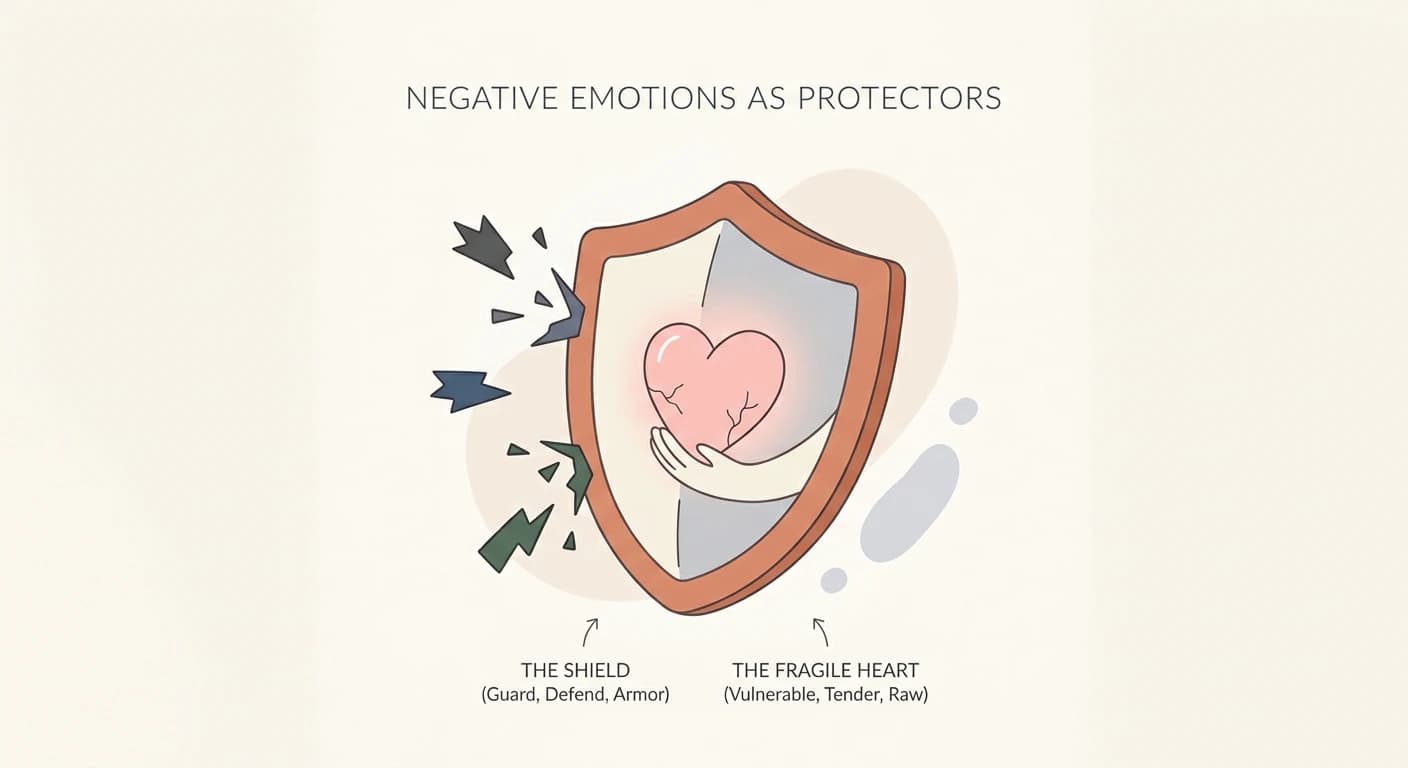
Examples of Negative Feelings with Positive Intentions
Example 1: Demotivation
Once, I felt completely unmotivated to work on projects I had envisioned for myself. I decided to dig deeper. To my surprise, I discovered that this feeling was trying to protect me.
How?
- If I didn’t feel motivated, I wouldn’t try new things.
- By not trying, I avoided the risk of failure and rejection.
Essentially, my brain created demotivation as a way to protect me from potential pain.
Mini-dialogue with Demotivation:
You: 'Why are you making me so tired and unmotivated?'
Demotivation: 'If you try this new project and fail, you'll be crushed. I'm keeping you safe by keeping you on the couch.'
You: 'Thank you for trying to protect me from failure. I appreciate your intention.'

Example 2: Anger
A friend of mine used to get angry whenever she felt unheard. Instead of calmly clarifying her point, she would lash out in frustration.
When she explored this reaction, she realized her anger was trying to reinforce boundaries. As a child, she had learned that anger was the only way to get others to listen to her.
If you struggle with similar intense emotions, you might find it helpful to watch our recorded IFS for Anger, Rage, and Bitterness workshop, which you can view anytime at your own pace.
Can These Negative Feelings Be Changed?
Absolutely! But not through force or suppression. Change comes from listening, understanding, and compassion.
Negative Feelings Are Mini-Characters Inside Us
Think of your negative feelings as mini-characters with specific roles, often referred to as IFS protectors:
- Demotivation protects you from rejection.
- Anger protects your boundaries.
- Jealousy might push you to improve or safeguard what matters to you.
Like loyal protectors, these parts won’t give up their roles until they’re sure your wounds are healed and you’re safe. (You can learn more about meeting protectors in IFS to understand this dynamic better.)

Suppressed Negative Feelings Don’t Disappear
When we suppress negative feelings, they often find new ways to express themselves, such as:
- Physical symptoms like headaches, body aches, or panic attacks.
- Phobias like fear of flying, driving, or confined spaces.
Healing Negative Feelings
To change a negative feeling, we must heal the old wound it’s protecting. Here’s a high-level overview of the process:
- Reactivate the memory of the painful experience.
- Reprocess the memory so that the negative emotions attached to it diminish.
- Re-store the memory in your brain with a new, more positive emotional association.
This process, called memory reconsolidation, rewires your brain to no longer need the old protection mechanism.

- Mistake 1: Trying to force the feeling to go away instead of listening to it.
- Mistake 2: Believing the feeling is you, rather than just a part of you.
- Mistake 3: Judging the feeling as 'bad' or 'wrong.'
Common Mistakes When Working with Negative Feelings
Why You Shouldn’t Go It Alone
This isn’t a DIY process! Without proper knowledge or training, digging into old wounds can cause more harm than good.
For professional support, consider therapy modalities like:
- Internal Family Systems (IFS)
- EMDR
- Coherence Therapy
- NLP
- EFT
A Personal Example
Not long ago, I felt completely unmotivated and wasted hours on social media and Netflix. After one IFS session and a good night’s sleep, I felt rejuvenated.
Although no one should expect instant results, memory reconsolidation can lead to faster and deeper healing compared to traditional talk therapy.
My Recommendation
For years, I thought I was a positive person because I was good at “controlling” my feelings. In reality, I was ignoring and suppressing my negative emotions, which eventually found new, harmful ways to express themselves.
Through IFS, I’ve discovered a new way to experience daily life—one that brings lasting peace, joy, and compassion.
If a feeling is too intense, don't force yourself to engage with it alone. It's best to work with a trained IFS therapist or practitioner who can help you navigate it safely.
Not at all! Accepting a feeling means you stop fighting it so you can understand its root cause. Once you understand it, it naturally begins to transform.
It varies. Some feelings shift quickly once they feel heard, while deeper, older wounds may take consistent time and professional support to heal fully.
Meditation is a great tool for awareness, but using it to bypass or ignore negative feelings (often called 'spiritual bypassing') prevents true healing. Use meditation to be with the feeling, not to escape it.
Frequently Asked Questions About Negative Feelings
The IFS Guide App offers 24/7 AI-guided IFS Sessions, Daily Check-Ins, adaptive Self-Healing Meditations, and Parts Mapping to visualize your Parts' relationships. Additionally, you can join the In-App Community, explore guided Trailheads, set Reminders, and Track Parts to support your team's shift toward Self-led leadership in real time.
Enhance Your IFS Journey with the IFS Guide App
In Conclusion
Instead of ignoring or fighting your negative feelings, try listening to them. Think of them as protectors with important messages about your inner world. By healing the wounds they guard, you’ll create lasting peace for yourself and those around you.

I
Written by
IFS Guide Editorial Team

Reviewed by
Sasha Eslami
Level 3 IFS Practitioner